
How Is an Executive MBA Different from an MBA — and Which Path Should You Choose?


- ExMBA
How Is an Executive MBA Different from an MBA — and Which Path Should You Choose?
In today’s rapidly evolving business landscape, many professionals and executives are asking an important question:
Should I pursue a traditional MBA or an Executive MBA (EMBA)?
While both programs aim to develop business leadership capabilities, they differ significantly in terms of participant profile, career objectives, learning experience, and strategic impact.
Participant Profile: The Difference Starts at the Beginning
MBA (Master of Business Administration)
• Designed for early-to-mid career professionals (typically 2–7 years of experience)
• Ideal for those seeking career transitions, promotions, or foundational-to-intermediate management skills
• Focuses on core business disciplines such as finance, marketing, operations, and management
Executive MBA (EMBA)
• Designed for mid-to-senior level executives, business owners, or leaders (typically 8–15+ years of experience)
• Aimed at enhancing strategic perspective and high-level decision-making capabilities
• Classrooms consist of experienced leaders, fostering deep peer learning and high-level networking
According to AACSB (2023), EMBA programs are specifically structured for experienced leaders and are often scheduled to accommodate full-time executives.
Learning Format: Intensity and Context Matter
Traditional MBA
• Offered in full-time or part-time formats
• Structured around core courses plus electives
• May require a thesis or final capstone project
Executive MBA
• Often delivered in block formats or weekend modules
• Emphasizes case-based learning and executive-level discussions
• Focuses on immediate application to participants’ organizations
• Capstone projects typically involve strategic initiatives or business plans
The Financial Times (2023) reports that EMBA programs often deliver stronger outcomes in career progression and salary growth among experienced executives compared to traditional MBA pathways.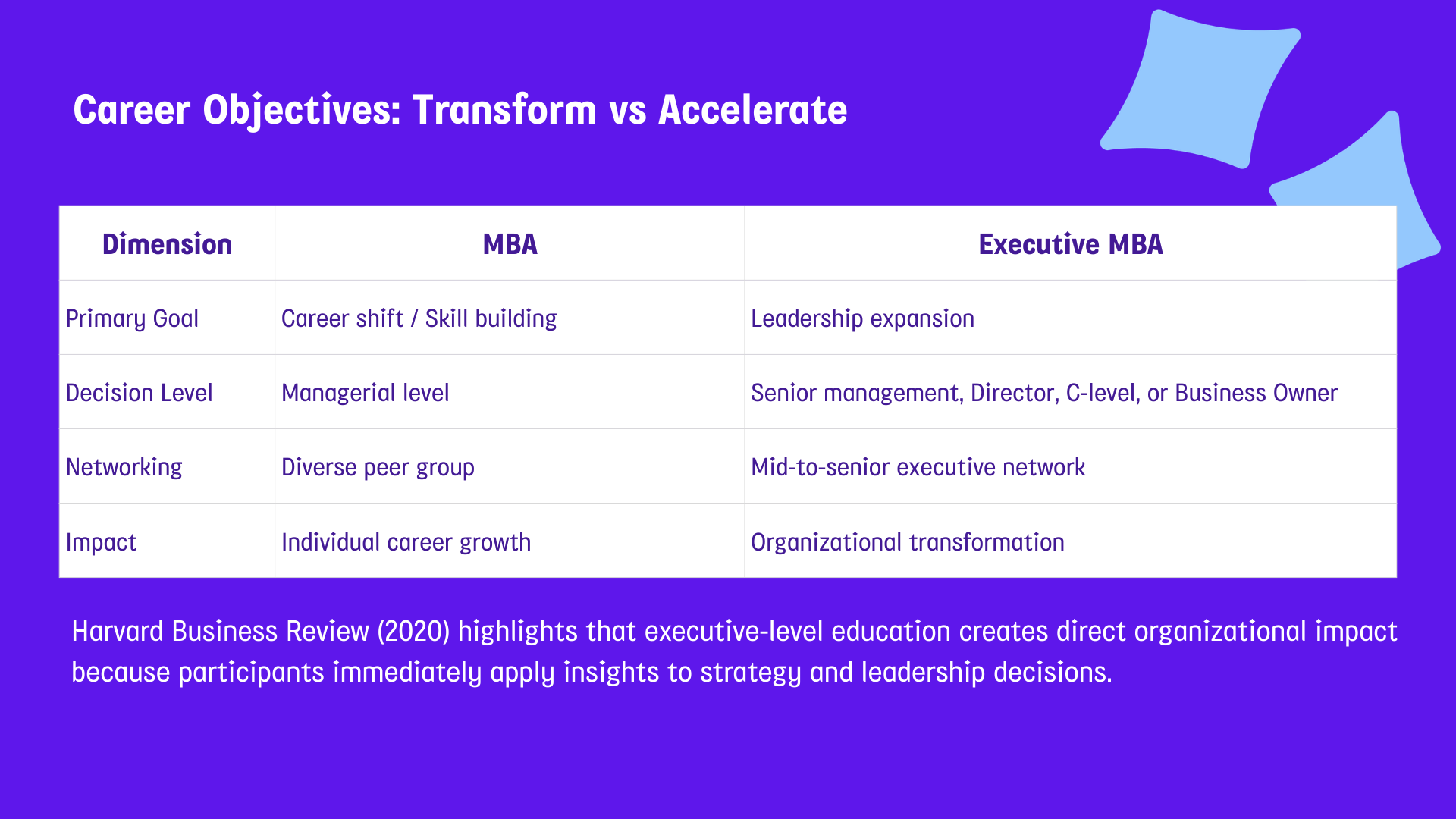
Strategic Perspective: Why EMBA Is Different
An EMBA goes beyond business knowledge. It emphasizes:
• Systems Thinking
• Managing Uncertainty
• Data- and finance-driven strategic decision-making
• Multi-generational leadership
The Economist (2022) notes that executive education plays a critical role in strengthening organizational competitiveness, particularly in volatile economic environments.
So, Which Should You Choose?
• If you are building your career foundation, planning a career switch, or strengthening core business knowledge, an MBA may be more suitable.
• If you are an executive, entrepreneur, or preparing for C-level leadership, an Executive MBA provides deeper strategic value.
An MBA builds readiness.
An Executive MBA elevates leadership.
In an era shaped by digital transformation, AI disruption, geopolitical uncertainty, and global competition, the question is no longer:
“Should I pursue a master’s degree?”
The real question is:
At what level do you want to lead?
Why Pursue an Executive MBA at DPU?
In today’s highly volatile business environment — driven by digital transformation, artificial intelligence, geopolitical shifts, and global competition — leadership demands more than experience alone. Decisions must be precise, agile, and data-informed.
The Executive MBA Program (ExMBA) at Dhurakij Pundit University (DPU) is specifically designed for mid-to-senior executives, entrepreneurs, and next-generation leaders who seek to elevate their capabilities and navigate the complexities of modern organizations.
The program develops Next-Generation Executives equipped with:
• Strategic Thinking
• Data & AI-Driven Decision Making
• The ability to lead within globalization, volatility, uncertainty, and intense global competition
A distinctive feature of DPU’s ExMBA is its Multi-Instructor per Module design.
Each module is led by a Module Moderator who integrates strategic perspectives, supported by distinguished academics and senior executives from leading institutions and corporations.
Every course includes:
• Executive Seminars
• Structured Networking activities
These create a strong Executive Network that extends beyond the classroom and fosters long-term business collaboration.
Participants strengthen their Management Knowledge & Skills, while enhancing core Capabilities & Competencies in:
• Business Analysis
• Strategic Planning
• Effective Execution
All designed to be measurable, practical, and immediately applicable to their own organizations.
If you are not simply seeking a degree,
but aiming to elevate your leadership impact and drive strategic transformation,
The Executive MBA (ExMBA) at DPU is your next step.
Learn more:
https://www.dpu.ac.th/th/course/profile/profile-executive-master-of-business-administration-exmba
References
AACSB International. (2023). Business School Programs Overview. Association to Advance Collegiate Schools of Business.
Financial Times. (2023). Executive MBA Ranking 2023. Financial Times.
Harvard Business Review. (2020). The Value of Executive Education for Senior Leaders. Harvard Business Publishing.
The Economist. (2022). Executive Education and Leadership Development Report. The Economist Group.
GMAC (Graduate Management Admission Council). (2022). Corporate Recruiters Survey Report.